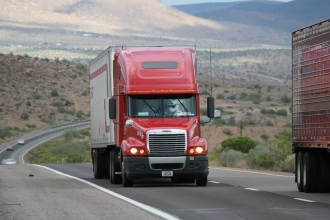
Commercial trucks have blind spots — sometimes called “no-zones” — that are dramatically larger than a passenger vehicle’s, and a significant share of serious truck accidents happen when a driver simply can’t see a car positioned in one of these areas. If you’ve been injured in a crash tied to a truck’s blind spot, a truck blind spot accident lawyer can help establish whether the driver failed to check properly, or whether another factor was really to blame.
Understanding a Truck’s Blind Spots
A commercial truck’s blind spots exist in four main zones, and they’re considerably larger than what most drivers assume:
- Directly in front of the cab, extending roughly 20 feet, where a driver may not be able to see a vehicle or pedestrian immediately ahead of the truck
- Along both sides of the trailer, extending the full length of the vehicle, where a car can be completely invisible to the driver for an extended stretch
- Directly behind the trailer, extending roughly 30 feet, since there’s no rear window offering the driver a direct view behind the vehicle
- Immediately behind the cab on both sides, an area drivers sometimes underestimate even though it technically falls within a mirror’s typical range of view
Federal regulations require commercial trucks to be equipped with mirrors designed to minimize these blind spots as much as possible, but even a well-designed mirror system can’t eliminate them entirely — which is exactly why lane changes, merges, and turns require deliberate, careful checking from a truck driver rather than a quick glance.
How Blind Spot Accidents Happen
- A driver assuming a lane or space is clear without physically checking mirrors and, where necessary, glancing over their shoulder before merging or turning
- A vehicle lingering in a blind spot for an extended period, which, while sometimes partly the other driver’s responsibility, doesn’t eliminate the truck driver’s duty to check thoroughly before any maneuver
- Turning at an intersection without accounting for a cyclist or smaller vehicle positioned in the truck’s front or side blind spot
- Backing up, particularly in parking lots or loading areas, where the rear blind spot creates serious risk for pedestrians and smaller vehicles
- Distraction or fatigue, which can reduce how thoroughly a driver actually checks their mirrors even when they believe they’ve done so
Why Blind Spot Accidents Are Often Severe
Because the driver frequently doesn’t realize a vehicle is present at all, blind spot accidents can escalate quickly — a truck may continue turning, merging, or backing up without any awareness that a collision is occurring or about to occur, sometimes pushing or dragging a smaller vehicle before the driver becomes aware of the impact. This lack of immediate driver awareness is part of what makes blind spot accidents distinct from other crash types, where at least one driver typically has some warning before impact.
Who Can Be Held Liable
The driver, for failing to properly check mirrors and blind spots before merging, turning, or backing up — a failure that’s often at the core of these cases.
The trucking company, if it failed to properly train the driver on blind spot awareness, or if it operated vehicles without properly functioning or positioned mirror systems.
A mirror or blind-spot monitoring technology manufacturer, in cases involving a defective or malfunctioning system that failed to alert the driver as intended.
The other driver, potentially sharing some fault depending on the specific circumstances, such as if they remained in a blind spot for an unusually long time without attempting to create visibility — though this doesn’t eliminate the truck driver’s fundamental duty to check before any maneuver.
How These Cases Are Investigated
An attorney investigating a blind spot accident typically examines the truck’s electronic logging device (ELD) data and speed at the time of the incident, dashcam footage if available, witness statements describing the sequence of events and how long the other vehicle had been in the area, the truck’s mirror configuration and any blind-spot monitoring technology it was equipped with, and, in serious cases, an accident reconstruction expert’s analysis of the vehicles’ positions leading up to the collision.
Building a Truck Blind Spot Accident Claim
- Evidence preservation, requesting ELD data and dashcam footage before it can be lost.
- Witness identification, since bystanders or nearby drivers may have seen how the accident unfolded and whether the truck driver made any visible effort to check before the maneuver.
- Reviewing driver training records, to determine whether the trucking company adequately trained the driver on blind spot awareness and defensive driving around no-zones.
- Damage calculation, accounting for the full scope of injuries and losses.
- Negotiation and, if necessary, litigation.
What Compensation May Be Available
A truck blind spot accident claim can potentially cover medical expenses (both current and future), lost wages and reduced earning capacity, property damage, pain and suffering, and wrongful death damages in fatal cases.
A Practical Note on Avoiding Truck Blind Spots
While this doesn’t affect liability after a crash has already happened, it’s worth knowing for future driving: a simple rule of thumb is that if you can’t see a truck driver’s face in their side mirror, they likely can’t see you either. Passing through a truck’s blind spot quickly rather than lingering alongside it can reduce the risk of ending up in a dangerous no-zone in the first place.
Getting Help After a Truck Blind Spot Accident
These cases often hinge on whether the driver made a genuine, thorough effort to check their blind spots before a maneuver — something that requires gathering witness accounts and technical evidence quickly before it’s lost. An experienced truck blind spot accident lawyer can investigate the specific circumstances and pursue compensation from the responsible party. Most truck accident lawyers offer a free consultation and work on a contingency fee basis, meaning there’s no upfront cost and no fee unless they win your case.